1. Introduction
In Lesson 28, you learned how to explain why something happens by giving a reason.
In this lesson, you’ll go one step further. Instead of simply answering “Why?”, you’ll learn how native speakers connect one event to another. This is called cause and effect, and it’s one of the most common thinking patterns in everyday English.
2. Pattern Discovery
Native speakers don’t speak in isolated sentences.
Look at these examples.
Example A
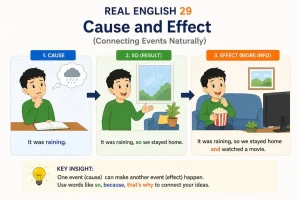
It was raining.
We stayed home.
These are two separate ideas. Now look again.
It was raining, so we stayed home.
Suddenly the two ideas become one logical pattern.
What pattern did you discover?
Pattern 1
Cause → so → Effect
Pattern 2
Because + Cause → Effect
Pattern 3
Effect + because + Cause
Pattern 4
Cause → That’s why → Effect
Notice something important:
Native speakers don’t memorize long grammar rules.
They connect ideas. That is the real pattern.
3. Pattern Fuel
Useful Words
- because — ເພາະວ່າ
- because of — ເນື່ອງຈາກ
- so — ດັ່ງນັ້ນ
- that’s why — ນັ້ນຈຶ່ງ…
- therefore — ດັ່ງນັ້ນ (ທາງການ)
- as a result — ຜົນກໍຄື
- due to — ເນື່ອງຈາກ
- consequently — ດັ່ງນັ້ນ / ຜົນຕາມມາ
Think of these words as bridges. They connect one idea to another.
4. Pattern Build
Now let’s build stronger sentences.
level 1
One fact
I was tired.
level 2
Add the cause and effect.
I was tired, so I went to bed early.
level 3
Add more information.
I was tired after working all day, so I went to bed early and felt much better the next morning.
5. Pattern Expansion
Native speakers rarely stop after one cause and one effect.
They often build a chain.
Basic
It rained.
↓
It rained, therefore, we stayed home.
↓
It rained all afternoon, therefore, we stayed home and watched a movie together.
6. Real Conversation
A: Why didn’t you come yesterday?
B: I wasn’t feeling well, so I stayed home.
A: Your English is getting much better.
B: I’ve been practicing every day, so I’m much more confident now.
A: Why is the road so crowded today?
B: There was an accident earlier, so traffic is moving very slowly.
7. Key Lesson Insight
Many learners think English is about learning grammar.
Native speakers think differently.
They connect ideas.
When you learn to express cause and effect, your English becomes clearer, more logical, and much easier to follow.
Remember:
Good English isn’t just about correct sentences.
It’s about connected thinking.
8. Challenge
Rewrite these ideas using a cause-and-effect pattern.
1 It was very hot. We stayed inside.
…………………………………………………………………………….
2. I practiced speaking. My confidence improved.
……………………………………………………………………………
3. The traffic was heavy. We arrived late.
…………………………………………………………………………..
4. She forgot her umbrella. She got wet.
…………………………………………………………………………..
5. I wanted to improve my English. I studied every day.
9. Summary
In this lesson, you discovered one of the most useful thinking patterns in English:
Cause → Effect
Instead of speaking in separate sentences, native speakers naturally connect ideas using words like because, so, that’s why, and as a result.
The more you practice this pattern, the more natural, logical, and fluent your English will become.
Further reading